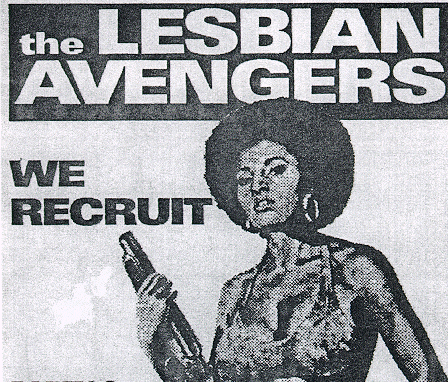
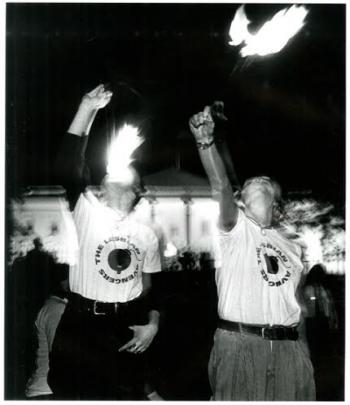
You have to read about these amazing, badass ladies. Fire eating became their symbol, here’s a blurb on its origin.
[It] grew out of tragedy. Last year, a lesbian and a gay man, Hattie Mae Cohens and Brian Mock, burned to death in Salem, Ore., after a Molotov cocktail was tossed into the apartment they shared. A month later, on Halloween, at a memorial to the victims in New York City, the Avengers (then newly organized) gave their response to the deaths. They ate fire, chanting, as they still do: “The fire will not consume us. We take it and make it our own.”
Just so everyone knows, today (Sept 9th) is the 25th anniversary of the Lesbian Avengers’ first public action!
from Wikipedia: ‘On their first action (September 9, 1992), the Lesbian Avengers targeted right-wing attempts to suppress a multicultural “Children of the Rainbow” curriculum for elementary schoolchildren. Ostensibly under attack for including lesbians and gay men in its lessons about diversity,[8] some activists like Ana Maria Simo charged that opponents, besides being homophobic, also had a racist agenda in battling the multicultural curriculum.[2]
Meeting in Queens School District 24 where the opposition to the “Rainbow Curriculum” was strongest, they paraded through the neighborhood with an all-lesbian marching band to a local elementary school where they gave out lavender balloons to children and their parents saying “Ask About Lesbian Lives.” They also wore tee-shirts reading, “I was a lesbian child.” [2]’
I’m perfectly capable of enjoying the idea of “person A, a hero, ‘saves’ person b, a villain, with the power of love” in a fictional context, and all the different ways it can play out, while also recognizing that it’s a bad idea to try to save someone from themselves if they’re dangerous in real life. I’m an adult and I understand the difference. My enjoyment if hero/villain ships in fiction does not inform my real life relationship choices. On the contrary, they allow a safe outlet me to explore and live out these ideas without suffering negative consequences in my real life.
This continued insistence by self-described feminists that I actually don’t know the difference, and am potentially endangering myself by consuming fiction featuring that trope, is not helpful. It’s not progressive or radical. It’s not liberating or empowering. It’s not “smashing the patriarchy.”
On the contrary, it’s nothing but a rehash of old misogynistic stand-bys: that women can’t be trusted to understand their own thoughts and emotions, that they have to be told what they feel and think and why, that women are blinded by innate naivety and compassion, or by sexual desire, that women need a guiding hand to protect them from their own bad judgment.
The fact that it’s women applying this to other women this time around. does not magically make it okay, does not make it less condescending, less patronizing, less violating. Women have been enforcing misogynistic social norms for other women for ages; this is nothing new. It’s no different than when my female Sunday school teachers told me that my body is inherently a temptation to sin, and I must take counter-measures to prevent others from falling from grace by covering it at the expense of my own comfort. It’s no different than when they told me that women who aren’t virgins are equivalent to chewed up gum or licked cupcakes. Sexism doesn’t stop being sexism because it’s enforced laterally.
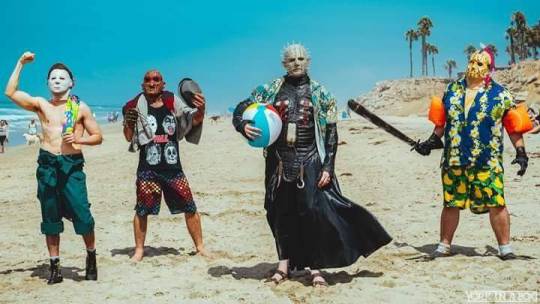
It’s funny that these people keep implying that women who enjoy this fictional trope have a savior complex. From where I’m sitting, we aren’t the ones trying to save people who don’t need or want to be saved.






 daisychainnihilism